
U.S. Customs, Immigration and Connecting Flights at JFK Airport
⏱️ Connection Time Calculator - JFK Airport
How much time do you really need for your JFK connection? Enter your arrival and departure terminals, and get an instant estimate — including immigration, security, and terminal transfers. No guesswork. No stress.
* Estimate based on JFK operational averages. Delays in Immigration (CBP) and Security Control (TSA) vary according to terminal flow, peak hours and season.
Developed by jfkfly.com
Quick Questions
Can I make an international-international connection without going through the whole process again?
No. JFK does not have a sterile corridor for this type of connection: if you arrive on an international flight, you must go through immigration, collect your checked luggage, and re-check it before your next flight — even if that flight is also international.
What if my connection is 100% domestic?
There's no immigration involved there, but if your next flight departs from another terminal, you do have to go through that terminal's security checkpoint again — each one has its own independent checkpoint.
How do I move between terminals if I need to change?
Using the AirTrain, free for transfers between terminals within the airport. Follow the signage to the AirTrain as soon as you know your next flight departs from another terminal.
I bought the legs separately, does that change anything?
Yes. If you booked the flights separately, you may have to complete the full arrival process: collect your luggage, and re-check in and drop off bags with the second leg's airline, as if it were a new trip.
What minimum connection time should I leave?
There is no single figure for every combination, but the more international legs your connection has, the more margin you should leave — especially if you don't have Global Entry. Always check the minimum required by your airline when booking.
Image
AI-generated image
Critical Points to Keep in Mind
Collect your luggage even if it's tagged to your final destination
If you arrive on an international flight, you must collect your checked bags at baggage claim and re-deliver them before your next flight — they don't transfer automatically, even with the same airline.
Verify which terminal your connecting flight actually departs from
Many airlines operate codeshare flights. The name on your reservation may not match the operating airline, and each may be in a different JFK terminal.
Airport construction can add extra time to any transfer
JFK's modernization project affects circulation and signage in various sectors. Add extra margin if your connection involves changing terminals during peak demand.
If you need reduced mobility assistance, coordinate it in advance
JFK recommends arranging assistance service directly with your airline before flying, rather than resolving it on the spot — several travelers report serious delays when requesting it on the fly.
Pros and Cons
- Pros:
- AirTrain free and frequent: connects the five terminals at no cost, available 24/7.
- Global Entry speeds up the longest step: the automated kiosk replaces the traditional immigration line for those who have it.
- Internal shuttle in Terminal 4: allows moving between concourses without going through security again.
- Cons:
- No sterile international-international corridor: you always have to go through immigration and full security again.
- Immigration times vary greatly: from minutes to over two hours, depending on how many international flights arrive simultaneously.
- Luggage never transfers automatically on a connection with an international leg, even with the same airline.
How Connections Work at JFK, by Flight Type
The process depends on the type of arrival and departure flight. Knowing it in advance avoids surprises and helps calculate the available time:
Domestic → domestic: the simplest scenario. You stay in the secure area and go directly to your gate, without immigration or additional security — unless your next gate is in another terminal, in which case you do have to go through that terminal's checkpoint again.
International → domestic or international: you must go through immigration (CBP passport control), collect your luggage from baggage claim, clear customs, and re-check it in the baggage re-drop area before heading to your next gate — and go through security again. This applies even if your next flight is also international: JFK does not have a sterile corridor for international-international connections.
With separate tickets: if your two legs are not connected in a single reservation, you may need to complete the full arrival process and check in again with the second airline, as if starting a different trip.
User experience:
- The most repeated and most serious case: passengers on international connections describe losing over an hour just in the luggage collection and re-check process, even before reaching the new gate.
- Several travelers compare this system unfavorably to international hubs in other countries where transit does not require full passport control — the difference generates more surprise than the delay itself.
- The immigration process varies greatly depending on the arrival terminal and time: there are reports of less than 2 minutes in some cases, and over 2 hours in others, depending on how many international flights land simultaneously.
- Those with Global Entry consistently report a much faster process than the traditional line, even during the busiest times.
Strategy: if your connection includes an international leg and you have little margin, prioritize carry-on luggage over checked luggage whenever possible, and notify an airline agent as soon as you land if you see time is tight.
Moving Between Terminals During a Connection
All JFK terminals are connected by the AirTrain, free for transfers between terminals. If your connecting flight departs from another terminal, follow the signage to the AirTrain as soon as you complete the corresponding process.
Exception within Terminal 4: to move between Concourses A and B within Terminal 4 itself, there is a free shuttle that avoids the long walk and does not require going through security again, as it keeps you in the secure area. Walking may be just as fast depending on the time, so it's not necessarily the fastest option.
Immigration and Customs (CBP) Upon Arrival at JFK
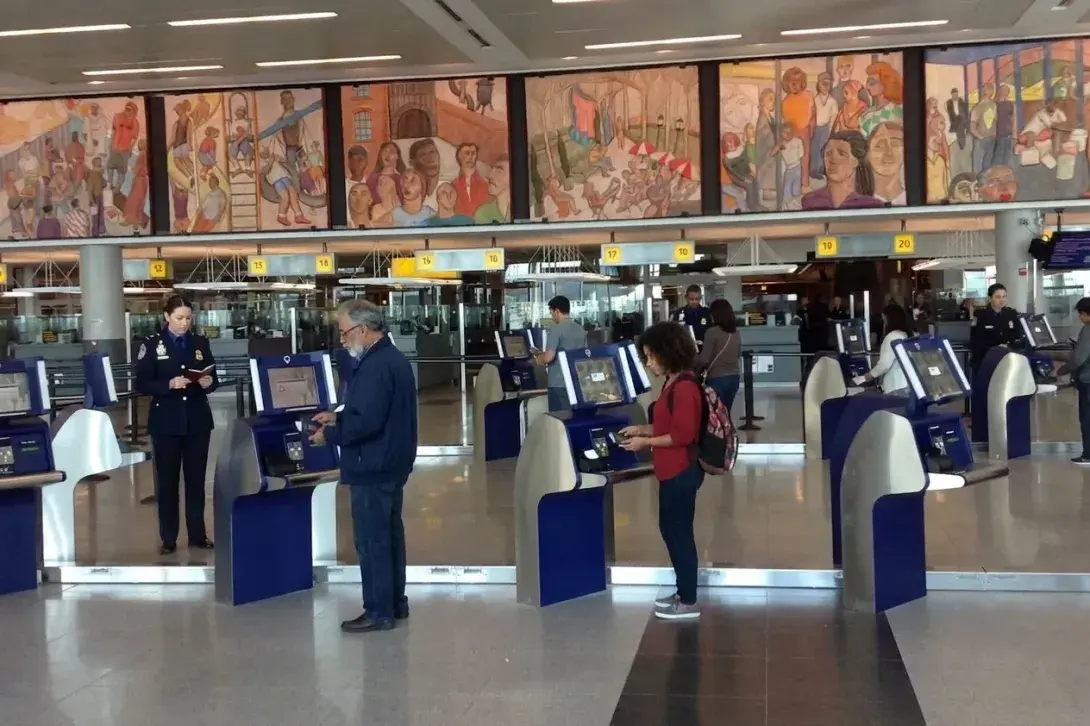
Passengers arriving on an international flight first go through CBP passport control, then baggage claim and customs. Those with Global Entry can use automated kiosks instead of the traditional line.
User experience:
- The disparity between terminals is the most marked pattern: some travelers describe processes of just a few minutes, while others report waits of over 3 hours with few control booths open, especially during high-demand times.
- Staff treatment appears polarized — reports of brusque treatment coexist with cases of good service, with no clear pattern except for the correlation with passenger volume at the time.
- Assistance to passengers with reduced mobility in this area appears repeatedly mentioned as a weak point, with long waits to get a wheelchair or accompaniment.
Strategy: have your passport and travel documents accessible before getting off the plane, and if you need reduced mobility assistance, coordinate it with your airline in advance rather than requesting it only upon landing.
